Hyvä stores pass Core Web Vitals more often: what Google’s figures for UK Magento stores show.
On Google’s own phone figures for 906 Magento stores on our list in November 2026, 69% of the stores on Hyvä passed all three Core Web Vitals against 56% of the rest, and they failed on loading about half as often and on layout shift less than half as often; responsiveness was the one measure where they were behind, failing on it about twice as often as the others.
Share of Magento stores on our list, phones, whole site
185 stores on Hyvä 721 other stores
Passed all three69%56%
Main content too slow (LCP)16%31%
Page jumps while loading (CLS)10%23%
Slow to respond to a tap (INP)10%5%
Google’s figures for whole sites (Chrome UX Report), read on 14th and 15th November 2026. Of 1,756 stores on our list, Google had all three figures for 1,088; the 182 we could not match to our theme data are left out.
From Google’s Chrome UX Report, read on 14th and 15th November 2026 for stores on our list of UK Magento stores (92% in the UK, the rest in Ireland).
Hyvä’s case rests on speed. In November 2026 I wanted to see how that looks across a large group of real stores, so we read Google’s own figures for the stores on our list of UK Magento stores and compared the ones on Hyvä with the rest. We’re a Hyvä Silver Partner, so we have an interest in the answer; the figures are Google’s, and the method is set out below.
What we measured
On 14th and 15th November 2026 we read the Chrome UX Report for 1,756 Magento stores on our list. These are Google’s figures from real Chrome visitors, for phones, for each whole site rather than one page. Google had figures for 1,179 of the stores and all three Core Web Vitals for 1,088. Our data identified 185 of those as Hyvä. We compared them with 721 others, which are mostly Magento 2 on other frontends but include 45 on Magento 1 and 14 on a PWA frontend, and left out 182 we couldn’t match to our theme data. Of the 906 compared, 838 are in the UK and 68 in Ireland.
A store passes when the 75th percentile of visits meets all three limits Google sets: the main content within 2.5 seconds (LCP), a response to taps and clicks within 200 milliseconds (INP), and layout shift of 0.1 or less (CLS).
Hyvä stores pass more often
Of the 185 Hyvä stores, 69% passed all three, against 56% of the others. The difference is mostly loading and layout. 16% of the Hyvä stores failed on LCP, against 31% of the rest, and 10% failed on CLS, against 23%.
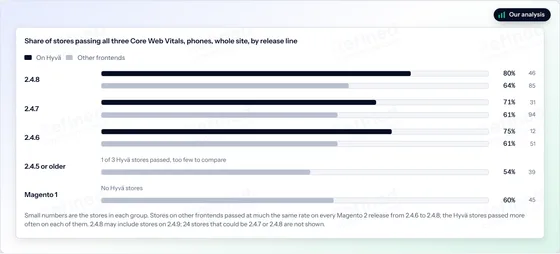
This compares two groups of stores at one moment. Hyvä stores may differ from the rest in other ways, such as when they were built and who looks after them, so I wouldn’t read the gap as the theme alone. The release a store runs doesn’t seem to account for it: among stores whose release we could identify, the gap held on each release line we could compare.
The one measure where Hyvä stores did worse
INP went the other way. About one in ten of the Hyvä stores failed on it, against about one in twenty of the others. It wasn’t the measure the Hyvä stores failed most often, which was still LCP, but it’s the only one where they were behind. INP measures how quickly a page responds to clicks, taps and key presses throughout a visit and reports close to the slowest of them, so a page can load quickly and still feel sluggish when someone opens the menu or adds to the basket.
These figures don’t tell us the cause on each store. When a Hyvä store fails on INP, the first places we look are the scripts added on top of the theme, such as the tag manager, chat, reviews and tracking, and the heavier interactive parts of the page: filters, galleries and the mini basket.
A passing homepage isn’t a passing store
Google keeps figures for individual pages and for the whole origin, and the two can disagree. A homepage can pass all three while the site as a whole fails, because the origin figures include every page shoppers use. Category pages, search and the basket are where shoppers filter, sort and tap most, so that’s where I’d expect a responsiveness problem to show first.
How to check your own store
Run PageSpeed Insights on your homepage and read the phone figures at the top. They come from real visitors over the previous 28 days; the lab score further down is a single test run. Then switch to the origin view, which covers every page of the site. If the store is on Hyvä, look at INP in particular.
Search Console’s Core Web Vitals report is the other place to look. It groups similar pages, so a failing group of category or product pages shows up there even when the homepage passes.
Sources
Dates, versions and bulletin numbers on this page were checked against each publisher’s own page on . Where a publisher changes its page after that date, its page is the authority.
Will moving to Hyvä make our store pass Core Web Vitals?
It makes it more likely, on our figures, but it isn’t certain. 31% of the Hyvä stores we looked at in November 2026 still didn’t pass all three on phones. What else runs on the page matters as much as the theme.
PageSpeed Insights says our homepage passes. Why does Search Console show failing pages?
Google keeps figures for individual pages and for the whole origin. The homepage is one page; Search Console groups similar pages and covers the rest of the store, including category pages, search and the basket.
How long until a fix shows up in Google’s figures?
Google’s field figures cover the previous 28 days of visits, so a fix shows gradually over the following weeks. Lab tests show the change the day it’s deployed.
Our store has no figures in PageSpeed Insights. Why?
Google only publishes figures for pages and origins that are sufficiently popular, meaning they have a minimum number of Chrome visitors; it doesn’t say what that number is. Of the 1,756 stores we checked, Google had no phone figures at all for 577.
Find out where your store stands, speed included, free.
Give us the address and we will read what the store already shows the world: release, support status, PHP, headers, hosting and any sign of a hijack. One page, by email, within two working days. Nothing is accessed or tested.
Magento Open Source, Adobe Commerce and Mage-OS stores
Read from public pages only, and free
Written up by an engineer who read the store
Free store health checkOne page, by email
What you receiveExample report
Magento Security and Upgrade Health Check
example-store.co.ukNeeds attention
Platform
Magento Open Source 2.4.4-p3
Adobe support
ended 12th April 2025
PHP
8.1, end of life
Frontend
Luma
Security headers
2 of 6 present
Hijack indicators
none found
What we would do first. Apply the outstanding security fixes, then plan the upgrade to a supported release.