Does a newer Magento release mean better Core Web Vitals? What Google’s figures show.
On Google’s phone figures for the 430 Magento stores on our list whose release we could match in November 2026, stores on newer releases passed Core Web Vitals only slightly more often than stores on older ones, while stores on Hyvä passed more often than other stores on the same release.
Share of stores passing all three Core Web Vitals, phones, whole site, by release line
On Hyvä Other frontends
2.4.880%4664%85
2.4.771%3161%94
2.4.675%1261%51
2.4.5 or older1 of 3 Hyvä stores passed, too few to compare54%39
Magento 1No Hyvä stores60%45
Small numbers are the stores in each group. Stores on other frontends passed at much the same rate on every Magento 2 release from 2.4.6 to 2.4.8; the Hyvä stores passed more often on each of them. 2.4.8 may include stores on 2.4.9; 24 stores that could be 2.4.7 or 2.4.8 are not shown.
From Google’s Chrome UX Report, read on 14th and 15th November 2026, matched to the release line our scanner read for each store on 14th November 2026.
Will an upgrade make the store faster? I’ve usually answered that it depends. In November 2026, with Google’s Core Web Vitals and our own release readings for the same stores side by side, there was a better answer to give.
Which stores, and how they were matched
We started from the 906 stores in our comparison of Hyvä and other frontends: stores for which Google had all three Core Web Vitals on phones for the whole site, read on 14th and 15th November 2026. For each we took the release line our scanner had read on 14th November. It could name the line for 385 of the Magento 2 stores, and 45 more ran Magento 1. The other 476 are left out, because we couldn’t tell which release they ran. 24 stores could be on either 2.4.7 or 2.4.8; they count towards 2.4.7 or later but aren’t shown line by line.
A store passes when the 75th percentile of visits meets all three of Google’s limits: main content within 2.5 seconds, a response to taps and clicks within 200 milliseconds, and layout shift of 0.1 or less. Stores counted as 2.4.8 may include some on 2.4.9, which our scanner can’t yet tell apart.
Newer releases passed only slightly more often
Of the 280 stores on 2.4.7 or later, 67% passed all three. Of the 105 on 2.4.6 or older, 59% passed. The 45 Magento 1 stores, on software Adobe stopped fixing in 2020, passed at 60%.
Some of that gap comes from Hyvä, because Hyvä stores are more often on recent releases. Taking them out leaves the stores on other frontends: 62% passed on 2.4.7 or later and 58% on 2.4.6 or older. Release by release it was 64% on 2.4.8, 61% on 2.4.7 and 61% on 2.4.6. With groups this size, a difference of a few points tells us very little either way.
On every release we could compare, Hyvä stores passed more often
Across all 280 stores on 2.4.7 or later, 78% of the 86 Hyvä stores passed against 62% of the other 194, a gap unlikely to be down to chance on groups that size. Line by line the groups get small, so read them as a pattern: on 2.4.8, 80% of 46 Hyvä stores against 64% of 85 others; on 2.4.7, 71% of 31 against 61% of 94; on 2.4.6, 75% of 12 against 61% of 51. On 2.4.5 and older only 1 of the 3 Hyvä stores passed, against 54% of the others, too few to compare. As a Hyvä Silver Partner, we have a stake in these figures.
That goes some way to answering a fair objection to our earlier comparison, that Hyvä stores might simply be on newer releases. Holding the release steady, the gap remained. It still compares groups of stores at one moment, and Hyvä stores may differ in other ways, so I wouldn’t read it as proof that the theme alone made the difference.
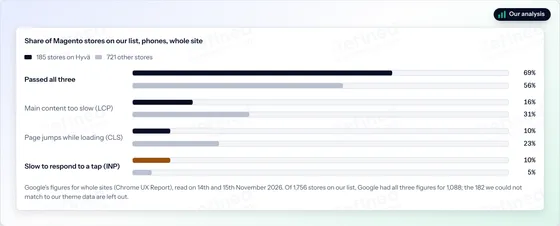
Hyvä stores weren’t better on every measure: on responsiveness they were behind, and that’s where we look first on a Hyvä store that fails.
Upgrades, speed and the frontend
Upgrade for the reasons Adobe’s lifecycle policy sets out: security fixes and support. On these figures I wouldn’t promise a faster store from the upgrade alone. If speed is the problem, the frontend and what runs on top of it are where I’d look, and an upgrade is a sensible time to change the frontend too, since the store is being tested end to end anyway.
Sources
Dates, versions and bulletin numbers on this page were checked against each publisher’s own page on . Where a publisher changes its page after that date, its page is the authority.
Will upgrading to 2.4.8 improve our Core Web Vitals?
Our figures don’t suggest a large change from the release alone. Upgrade for Adobe’s security fixes and support; for speed, look at the frontend and at what runs on the page.
Why compare stores on the same release?
Hyvä stores are more likely to be on a recent release, so a plain Hyvä-against-the-rest comparison could be measuring the release. Comparing within each release line takes that out of the picture.
Do these figures prove Hyvä makes a store faster?
No. They compare groups of real stores at one moment, and Hyvä stores may differ from the rest in other ways, such as when they were built and who looks after them. They take the release out of the picture, but they can’t show cause.
Where are Hyvä stores weaker?
Responsiveness. In the same Google figures about one in ten Hyvä stores failed on Interaction to Next Paint, against about one in twenty of the others. Our article on Hyvä and Core Web Vitals sets out where we look first.
Find out which release and frontend your store runs, and how it scores, free.
Give us the address and we will read what the store already shows the world: release, support status, PHP, headers, hosting and any sign of a hijack. One page, by email, within two working days. Nothing is accessed or tested.
Magento Open Source, Adobe Commerce and Mage-OS stores
Read from public pages only, and free
Written up by an engineer who read the store
Free store health checkOne page, by email
What you receiveExample report
Magento Security and Upgrade Health Check
example-store.co.ukNeeds attention
Platform
Magento Open Source 2.4.4-p3
Adobe support
ended 12th April 2025
PHP
8.1, end of life
Frontend
Luma
Security headers
2 of 6 present
Hijack indicators
none found
What we would do first. Apply the outstanding security fixes, then plan the upgrade to a supported release.