Security and patching
Black Friday on Magento: the security and speed checks that still matter this week
Security fixes, the Admin, checkout scripts, the cache, firewall rules and who is on call, for a Magento store already in its change freeze.
When we read the robots.txt files of 1,390 UK and Irish Magento stores in November 2026, about one in five opted out of AI training, most of them through Cloudflare’s managed robots.txt, while fewer than 3% blocked the crawlers that put sites into ChatGPT, Claude or Perplexity search answers.
 Rowan BurgessFounder, Refined Commerce
Our own data
Share of the 1,390 robots.txt files that disallow each crawler from the home page
Training controls
Search crawlers
Fetchers sent when a user asks
Bars are drawn to a 0 to 25% scale. UK and Irish Magento stores, November 2026; the other 502 stores in the check returned no readable robots.txt.
Some merchants want AI companies kept away from their content; others want AI assistants to recommend their products. A store’s robots.txt is where it says which crawlers may fetch what, so in November 2026 we read that file for a sample of UK and Irish Magento stores.
We fetched the robots.txt of 1,892 Magento stores. 1,390 returned a file we could read. The rest returned an error or a web page instead of a robots.txt file, and 37 had no robots.txt at all. For each file we asked whether it disallows the home page to eleven crawlers, reading it by the published robots.txt rules; an unusual file may be read differently by some crawlers.
The 1,892 weren’t a random sample. They included proportionally more Hyvä stores, fewer Magento 1 stores and more Irish ones than UK and Irish Magento stores as a whole, so the shares may not hold for all of them.
275 of the 1,390 files, about one in five, disallowed at least one of the three names that control AI training: GPTBot by 267, ClaudeBot by 258 and Google-Extended by 234. Google-Extended isn’t a separate crawler; Google reads it as an instruction for its existing crawlers. The crawlers that index sites for AI search answers were rarely blocked: PerplexityBot by 34, OAI-SearchBot by 25 and Claude-SearchBot by 18. 38 files, 2.7%, blocked at least one of those three, and some of those look like blanket blocks rather than AI choices: 8 of the 38 also disallowed Googlebot, and 7 disallowed every crawler we checked.
The fetchers that visit a page when someone asks an assistant a question were blocked about as rarely: ChatGPT-User by 39, Perplexity-User by 20 and Claude-User by 18. Those 8 files that disallowed Googlebot itself from the home page are the ones I’d look at first, because on a shop that usually costs search traffic.
198 of the 275 files that opted out of AI training were Cloudflare’s managed robots.txt, which Cloudflare writes on a site’s behalf when the owner sets a policy for AI crawlers in its dashboard. Where the site already has a robots.txt, Cloudflare puts its own rules in front of it. Its documented example disallows GPTBot, ClaudeBot and Google-Extended among others, and adds a content signal saying search is allowed and AI training isn’t.
For most of these stores, then, the AI rules came from a setting at their CDN, and that setting is aimed at training rather than search. 199 files in the check were Cloudflare-managed, so almost every store using it had opted out of AI training.
The difference matters because the two kinds lead to different places. OpenAI says disallowing GPTBot indicates that a site’s content shouldn’t be used to train its models, while a site that opts out of OAI-SearchBot won’t be shown in ChatGPT search answers. Anthropic draws the same line between ClaudeBot and Claude-SearchBot, and Perplexity says PerplexityBot is there to show and link sites in its search results and isn’t used to train foundation models. Google says Google-Extended doesn’t affect inclusion or ranking in Google Search, though it does keep pages out of grounding with Google Search on Vertex AI.
So a store can keep its content out of model training and still be found in ChatGPT, Claude or Perplexity search answers, which is what most of the Cloudflare-managed files already allow. A file that keeps training out and leaves search open can look like this; crawlers without a rule of their own fall under the last one:
User-agent: GPTBot
Disallow: /

User-agent: ClaudeBot
Disallow: /

User-agent: Google-Extended
Disallow: /

User-agent: OAI-SearchBot
Allow: /

User-agent: *
Allow: /
Disallowing OAI-SearchBot, Claude-SearchBot or PerplexityBot cuts a store’s chances of appearing in that vendor’s search answers, whether or not anyone meant it to.
Open your domain followed by /robots.txt in a browser. Look for lines that start with User-agent and name GPTBot, ClaudeBot, Google-Extended, OAI-SearchBot, Claude-SearchBot or PerplexityBot, and check the Disallow line under each. If the file is Cloudflare’s, the AI policy is set in your Cloudflare dashboard rather than in Magento. Bear in mind that robots.txt is a request: a firewall rule can block a crawler without appearing in it, and a fetcher acting for a user may not read it at all.
Dates, versions and bulletin numbers on this page were checked against each publisher’s own page on . Where a publisher changes its page after that date, its page is the authority.
Not out of ChatGPT search. OpenAI says GPTBot is for training its models, and that OAI-SearchBot is the crawler that decides whether a site is shown in ChatGPT search answers.
Google says it doesn’t: Google-Extended controls whether a site’s content helps improve Gemini and Vertex AI, and has no effect on inclusion or ranking in Google Search.
It’s a request, and following it is up to the crawler. Cloudflare’s own documentation says so, and points to its blocking tools for anyone who needs to enforce it. Perplexity says its user-requested fetcher generally ignores robots.txt.
Open your store’s robots.txt in a browser. Cloudflare’s managed rules are marked as Cloudflare’s and sit above anything you wrote yourself.
Security fixes, the Admin, checkout scripts, the cache, firewall rules and who is on call, for a Magento store already in its change freeze.
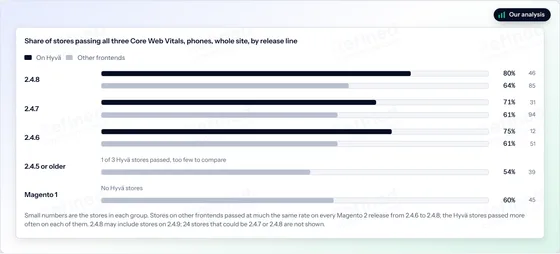
Google’s phone figures for UK and Irish Magento stores matched to the release each runs: how much the release mattered, and how Hyvä stores compared on the same release.
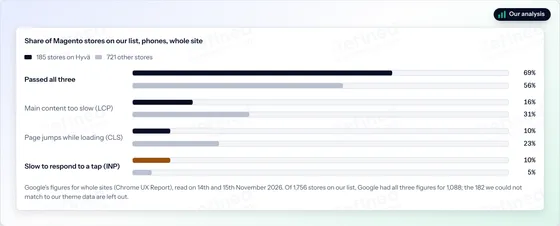
Google’s phone figures for UK and Irish Magento stores in November 2026: how often Hyvä stores pass, and why a passing homepage can hide a failing store.
Give us the address and we will read what the store already shows the world: release, support status, PHP, headers, hosting and any sign of a hijack. One page, by email, within two working days. Nothing is accessed or tested.
What we would do first. Apply the outstanding security fixes, then plan the upgrade to a supported release.