Magento or Shopify? How a UK merchant should decide.
Shopify takes the platform off your hands for a monthly fee and a set of fixed rules. Magento lets you build almost anything but leaves you running it. Which suits you depends on what a year of each would cost you, and on how much of your business sits in the parts Shopify won’t let you change.
£14k Shopify Grow£23k Magentoa year to run Store A£500,000 a year online, card fees included
£51k Shopify Advanced£56k Magento£66k Shopify Plus, if neededa year to run Store B: the Shopify plan it needs decides which is cheaper£2 million a year online, card fees included
A year of each platform for our two example stores, to the nearest £100
Everything except card feesCard feesHatched: only if Store B needs Plus
Store A, £500,000 a year online
Shopify Grow£14,300
Magento£22,800
Store B, £2 million a year online
Shopify Advanced£51,100
Magento£55,900
Shopify Plus, if needed£65,600
Bars are drawn to scale from £0. Store B would need Shopify Plus only if its B2B catalogs or checkout went beyond what Advanced allows; Plus is shown at its starting price.
Worked examples from published prices read on 17th November 2026. Our own upkeep is our estimate of the hours needed, at our hourly rate. Shopify Plus is shown at its starting price. Card fees assume standard UK cards: Shopify Payments on Shopify, Stripe on Magento.
In our own research in 2026, Shopify ran on more than ten times as many .co.uk domains as Magento 2, and many Magento merchants wonder whether they should follow. We build on both platforms. This is how I’d weigh it: the money first, then the limits that decide which Shopify plan the money is for.
What a year of each costs
In both examples, on Shopify below Plus, the subscription is the smallest line in the bill. Card fees and upkeep are where most of the money goes, plus hosting on Magento, so a price list on its own won’t tell you which platform is cheaper. We priced two example stores from published rates. Our own time is our estimate of the hours each store needs, at our hourly rate.
Store A
Store B
Online sales a year
£500,000
£2 million
Orders a year
About 8,300 at £60
25,000 at £80
Products
1,000
5,000
Trade customers
None
Some, on up to 3 price lists (Shopify’s B2B catalogs)
Both stores take standard UK cards only: Shopify Payments on Shopify, Stripe on Magento. A Shopify store using another payment provider may also pay Shopify’s own transaction fee (see the questions below). Email marketing, ERP connectors and the like are left out of both, as if they cost the same on either platform; a store whose integrations would change should add them.
Store A
Shopify Grow
Magento Open Source
Platform
£588£49 a month
£0
Hosting
Included
£5,590Hypernode Jackal S, dedicated
Card fees
£10,5831.7% + 25p
£9,1671.5% + 20p
Apps or modules
£1,200 allowedIncludes Judge.me reviews, $15 a month (£136 a year); filters with Shopify’s free Search & Discovery
£1,150Sansec Secure, €115 a month billed yearly, for stores up to €3m revenue
Looking after it
24 hours at £80Our estimate, a year
75 hours at £80Our estimate, a year: patching, monitoring and small fixes
Upgrades
Included
15 hours at £80Our estimate for each upgrade, one every three years: 5 hours a year in the totals
A year
Shopify GrowAbout £14,300
MagentoAbout £22,800
A year without card fees
About £3,700
About £13,600
Shopify and Hypernode on yearly billing. Our hours count at £80 each in the totals, with a third of each upgrade counted each year. No VAT is added to any figure: Hypernode’s prices and our hourly rate exclude VAT; Shopify’s, Stripe’s, Sansec’s and the apps’ pricing pages don’t say. Sansec converted from euros and app prices from dollars at the European Central Bank’s reference rates of 17th November 2026.
Store B
Shopify Advanced
Magento Open Source
Shopify Plus
Platform
£3,108£259 a month
£0
£21,600From £1,800 a month
Hosting
Included
£5,590
Included
Card fees
£36,2501.5% + 25p
£35,0001.5% + 20p
£32,2501.3% + 25p
Apps or modules
£6,000 allowedCovers Judge.me reviews and Boost’s Convert plan for search and filters, from $299 up to $599 a month for stores with under $400,000 of sales a month
24 hours at £80Our estimate for each upgrade, one every three years: 8 hours a year in the totals
Included
A year
Shopify AdvancedAbout £51,100
MagentoAbout £55,900
Shopify PlusAbout £65,600
A year without card fees
About £14,900
About £20,900
About £33,400
As for Store A, except Shopify Plus, which is shown at its starting price of £1,800 a month; Shopify sells Plus on one- or three-year terms. Store B would need Plus if its trade accounts needed more than three B2B catalogs, and might if its checkout needed changes Advanced doesn’t allow (see the next section).
For Store A, Shopify is about £8,500 a year cheaper. Card fees are close on both, so most of the gap is hosting, which Shopify’s subscription includes, and the extra upkeep Magento needs. Depending on its traffic, a store this size might also run on Hypernode’s Falcon M cloud plan, at £204 a month billed monthly. That would take about £3,100 off the hosting line, but the stores we look after on Hypernode are all on dedicated plans.
For Store B, card fees are most of the bill on Shopify Advanced and on Magento, and about half of it on Plus. Shopify Advanced comes out about £4,800 a year cheaper than Magento. If the trade accounts or the checkout push the store onto Shopify Plus, Magento is about £9,700 a year cheaper instead, which is why the limits in the next section decide the sum.
The “looking after it” and upgrade lines are our estimates of the hours each store needs, at our standard rate of £80 an hour plus VAT. For Store B, Magento needs about 86 more of those hours a year than Shopify Advanced, so an agency charging more than we do for the same hours would widen Shopify’s lead.
Magento Open Source has no licence fee. Adobe Commerce, the paid edition, is licensed by Adobe on its own terms. Either way you pay for hosting and for someone to test and apply security patches. Adobe gives each release line three years of standard support from its release, so every few years the store also has to move up a line, usually with a newer PHP version and a round of module updates. Some Adobe Commerce lines get an extra year of extended support. Our guide to 2.4.7’s end of support has the current dates, and our census of UK Magento releases shows how many stores fall behind.
The cost of moving
Moving platform is a project of its own. What it costs depends on the store’s products, integrations and design, so it isn’t in the tables. It can be weighed against the yearly difference instead.
Over three years, Store A would spend about £68,400 staying on Magento and about £42,900 on Shopify. A move that costs less than about £25,500 pays for itself within three years on these figures, if sales, prices and upkeep stay as they are.
Store B would spend about £167,600 staying, about £153,400 on Shopify Advanced and about £196,800 on Shopify Plus. On the same basis, a move to Advanced pays for itself within three years if it costs less than about £14,300. A move to Plus doesn’t pay for itself on these running costs at all.
Where Shopify’s rules start to cost you
Trade selling. Shopify B2B is on every plan, but below Plus you get up to three B2B catalogs. A store selling to many trade accounts on their own price lists will run out of room on Basic, Grow or Advanced, and Plus changes the monthly sum.
The checkout. Shopify’s pricing page lists checkout customisation as limited on Basic, Grow and Advanced and full only on Plus, so a checkout with custom steps or logic may need Plus, or may have to change.
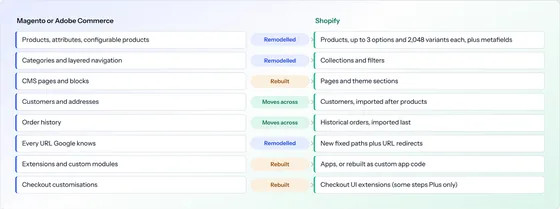
Product structure. A Shopify product can have up to three options, so anything configured on more than three attributes in Magento has to be remodelled. The Magento to Shopify migration guide covers how that, the URL changes and the data move are handled, and which kinds of store tend to suit each platform.
What you get for running Magento
You keep control. Pricing rules, checkout steps, product structure, URLs and integrations can be built the way the business works, and the code and data sit on hosting you choose. How much that is worth depends on the store. Trade pricing and complicated products tend to need it; a simple catalogue on list prices often doesn’t.
If you stay, look at the frontend
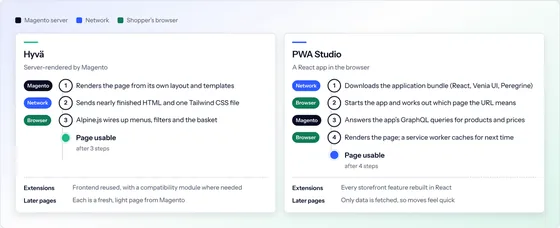
Some of what makes an older Magento store feel dated is Luma, the default frontend: it is heavy on phones and slow to change. Hyvä replaces it and leaves the rest of Magento where it is. The Hyvä Theme is free and open source; Hyvä Checkout, Hyvä UI and Hyvä Commerce are paid, and some modules need compatibility work, so the cost is mainly the build. We are a Hyvä Silver Partner, so weigh what follows with that in mind.
In our own reading of Google’s phone figures for UK Magento stores, Hyvä stores on current releases passed all three Core Web Vitals more often than other Magento stores on the same releases, set out in Magento release and Core Web Vitals. Plenty of non-Hyvä stores pass too. That is a comparison, not proof that Hyvä caused the difference; Hyvä and Core Web Vitals explains why. A slow host or a heavy tag manager will still drag a Hyvä store down.
How I’d decide
Search-volume estimates we took in October 2026 put UK searches at about 480 a month for “magento or shopify” and about 320 for “magento vs shopify”, so the question comes up often.
Sources
Dates, versions and bulletin numbers on this page were checked against each publisher’s own page on . Where a publisher changes its page after that date, its page is the authority.
In our two worked examples it is cheaper to run, unless the store needs Shopify Plus. A store selling £500,000 a year online costs about £14,300 a year on Shopify and £22,800 on Magento, card fees included. At £2 million it is about £51,100 on Shopify Advanced against £55,900 on Magento, but about £65,600 if the store needs Shopify Plus, at its starting price. The upkeep in those sums is our estimate of the hours each store needs, and the move itself is a project whose cost depends on the store.
Can Shopify handle B2B and trade customers?
Up to a point. Shopify B2B is on every plan, but Basic, Grow and Advanced allow up to three B2B catalogs; Shopify Plus allows unlimited catalogs. Stores with customer-specific prices, quotes or credit terms built into the checkout should test their real cases on Shopify before committing.
Do I have to use Shopify Payments?
No. You can use another payment provider, but Shopify may then charge its own third-party transaction fee as well: 2% on Basic, 1% on Grow, 0.6% on Advanced and 0.2% on Plus, as Shopify’s UK pricing page listed them on 17th November 2026. Our worked examples assume Shopify Payments.
Is Magento dying?
It is much less common than Shopify among .co.uk shops: in our own research in 2026 we found more than ten times as many .co.uk domains on Shopify as on Magento 2. Adobe still publishes new release lines with support dates for it, and it remains the stronger fit for stores with complicated catalogues, trade pricing or heavy integrations.
Can we upgrade Magento now and move later?
Yes. An upgrade does not lock you in. Some merchants upgrade to stay supported and plan a move for a quieter year. The upgrade still has to be paid for, so weigh it against when you would move: it makes most sense when your release line’s support would end before the move is done.
Weighing it up? See what your Magento store shows the world first, free.
Give us the address and we will read what the store already shows the world: release, support status, PHP, headers, hosting and any sign of a hijack. One page, by email, within two working days. Nothing is accessed or tested.
Magento Open Source, Adobe Commerce and Mage-OS stores
Read from public pages only, and free
Written up by an engineer who read the store
Free store health checkOne page, by email
What you receiveExample report
Magento Security and Upgrade Health Check
example-store.co.ukNeeds attention
Platform
Magento Open Source 2.4.4-p3
Adobe support
ended 12th April 2025
PHP
8.1, end of life
Frontend
Luma
Security headers
2 of 6 present
Hijack indicators
none found
What we would do first. Apply the outstanding security fixes, then plan the upgrade to a supported release.