Is your store ready for peak season? What we measured, and how to measure yours.
A store is ready for peak when real shoppers on phones see it pass all three Core Web Vitals, can complete checkout without barriers, and the platform is patched and frozen before Black Friday on 27th November 2026; the measures behind our 2024 ranking let any Magento, Adobe Commerce or Shopify merchant check this for free.
14th to 19th NovProveLoad-test, place real test orders, check every payment method
From 20th NovFreezeOnly security patches and fixes for broken things go live
27th to 30th NovTradeBlack Friday to Cyber Monday, someone on call
Good, at the 75th percentile of real visits
2.5 sLCP Largest Contentful Paint
200 msINP Interaction to Next Paint
0.1CLS Cumulative Layout Shift
Four weeks to Black Friday 2026, and the three field thresholds every page should pass. Thresholds from web.dev; plan by Refined Commerce, 31st October 2026.
Peak season is when an online store is tested in public, and weaknesses that were tolerable in March cost orders in November. In December 2024 we published a ranking of large UK ecommerce sites on the measures that decide whether a shopper stays.
What did the 2024 peak-season ranking measure?
Speed and stability from Google’s Core Web Vitals, accessibility faults found by an automated engine, and search authority. For each site we took Largest Contentful Paint, Interaction to Next Paint and Cumulative Layout Shift from Google PageSpeed Insights, on mobile and on desktop; counted the accessibility issues reported by the axe engine, the same automated checks many developers run before a deployment; and took Ahrefs’ domain rating as a measure of standing in search. Each factor was scored and combined into one figure per site and per sector. The idea was simple: these are the things a shopper feels in December, a page that appears quickly, responds when tapped, does not jump about, works for everyone and can be found.
Why we no longer publish the brand scores
They were a single snapshot from late 2024, and we have not refreshed them. Large sites change their storefronts every week, Core Web Vitals field data is a rolling 28-day window, and an automated accessibility count can move with a single release. A brand-by-brand table measured in 2024 and presented in 2026 would tell you about the past while reading as if it described the present. We have not repeated the measurements since, so we have removed the individual results and the sector table from this page. The method remains, and it is more useful to a merchant anyway, because it can be run on their own store this week.
What should you measure before peak?
Measure Core Web Vitals field data for the pages that take money (home, a busy category, a best-selling product and the checkout), accessibility faults on the same pages, and the platform’s own health, which for Magento means patch state. All of it is free. Google publishes the thresholds: a page passes when, at the 75th percentile of visits, Largest Contentful Paint is within 2.5 seconds, Interaction to Next Paint is 200 milliseconds or less and Cumulative Layout Shift is 0.1 or less. In our case studies, Tile Merchant, OutdoorLiving.ie, Dormeo, Bad.no and LaserMaster all passed the three on phones when we read their field data in October 2026.
Measure
Good
Where to read it
What it tells you
Largest Contentful Paint
≤ 2.5 s
PageSpeed Insights, field data
How soon the main content appears
Interaction to Next Paint
≤ 200 ms
PageSpeed Insights, field data
How quickly the page responds to a tap
Cumulative Layout Shift
≤ 0.1
PageSpeed Insights, field data
How much the page jumps as it loads
Accessibility faults
None on checkout
axe, in the browser’s developer tools
Barriers that stop some customers buying
Platform health
Supported and patched
Your release notes, or our free health check
Whether a known flaw is open during your busiest weeks
Thresholds from web.dev; PageSpeed Insights and Chrome UX Report behaviour from Google’s documentation, checked 31st October 2026.
Field data against lab data
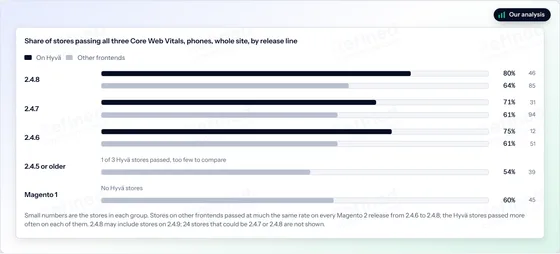
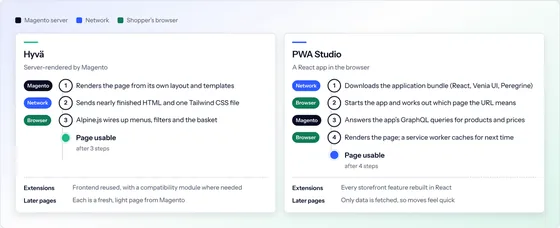
Field data counts, because it is what your customers actually experienced. PageSpeed Insights shows two kinds of result. Lab data comes from Lighthouse, which simulates one page load on one device and connection; it is good for finding causes. Field data comes from the Chrome UX Report and covers real Chrome users’ experiences over the previous 28-day collection period; Core Web Vitals are assessed on it. Field data only exists for pages and sites with enough visits, and Google does not disclose the exact threshold. When a page has too little, PageSpeed Insights shows the whole origin instead, which still reflects real visits. For a slow Magento store, the frontend is usually the cause; our comparison of Hyvä and PWA Studio explains why.
What usually slows a store down at peak?
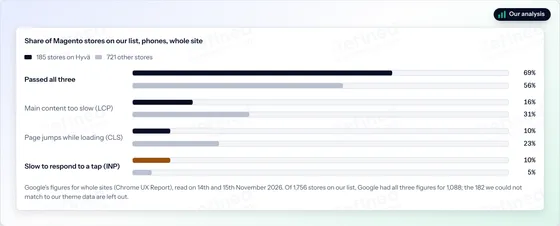
Mostly the frontend and the scripts added to it. In our experience, the slow Magento stores we are asked to look at are rarely short of server capacity; they are carrying a heavy frontend, usually Luma, plus marketing and chat scripts that each seemed harmless when added. On Shopify the equivalent is app scripts accumulating in the theme. Layout shift usually comes from images and banners without reserved space, late-loading promotional bars and fonts that swap. These are the cheap fixes and belong in the first two weeks. A full frontend replacement, such as a move from Luma to Hyvä, is the right answer for many slow Magento stores, but not one to start four weeks before Black Friday.
Bot protection needs tuning before peak so that it never challenges real customers; try any new firewall rule in log-only mode first.
Preparing in the weeks before Black Friday
Working back from Black Friday gives a plan that fits in four weeks. For 2026, Black Friday falls on Friday 27th November and Cyber Monday on 30th November, and the figure above puts dates on each stage.
Measure, four weeks out. Field data for home, category, product and checkout on mobile and desktop; an axe pass on the checkout; the platform’s patch state.
Fix the cheap things first, in the next two weeks. Image sizes and reserved space, removal of scripts nobody uses, and any accessibility fault on checkout.
Prove it, the week before the freeze. Real test orders with every payment method and delivery option, a load test of the busiest pages, and a check that stock and order integrations keep up.
Freeze for the last week or so. Only security patches and fixes for things that are broken go live, each tested on staging first.
Trade with someone on call. Agree who watches errors, payments and stock levels, and how quickly they can act.
For Magento and Adobe Commerce stores, plan one exception into the freeze. Adobe published a scheduled security bulletin on the second Tuesday of every month from July to October 2026, but none for Commerce on Tuesday 10th November. As at 16th November, the most recent is APSB26-153 of 13th October, a Priority 2 update. Adobe asks for Priority 2 updates within 30 days and Priority 1 updates as soon as possible, so if October’s update is not yet on the store, apply it on staging before the freeze, and keep the emergency lane open: in September Adobe published a Priority 1 hotfix outside its schedule for a vulnerability already being exploited. How Magento security patches work explains the priorities.
Sources
Dates, versions and bulletin numbers on this page were checked against each publisher’s own page on . Where a publisher changes its page after that date, its page is the authority.
No. The scores were taken once, in late 2024, and we have not refreshed them, so we no longer publish the table or the brand-by-brand findings. Sites change every week, and a ranking presented today on 2024 measurements would mislead. The method is set out on this page so you can run it on your own store.
Why does PageSpeed Insights show no field data for our store?
Field data comes from the Chrome UX Report, which only includes pages and origins with enough real visits to be statistically reliable; Google does not publish the exact threshold. When a page has too little data, PageSpeed Insights falls back to the whole origin, and when the origin has too little, it shows lab data only.
Is a Lighthouse score of 90 good enough?
It is a useful lab measurement for debugging, taken on one simulated device and connection. Google assesses Core Web Vitals on field data from real users at the 75th percentile, so a store can score well in the lab and still fail with real shoppers on mid-range phones, or the reverse.
Does accessibility matter for peak trading?
Yes, commercially and legally. A barrier on the checkout can stop a customer finishing an order, and UK service providers have duties under the Equality Act 2010. Automated tools such as axe find many common faults quickly, but not all of them, so test the checkout with a keyboard and a screen reader as well.
Should we deploy anything during the freeze?
Only security patches and fixes for things that are broken, each tested on staging first. New features, theme changes and extension updates can wait until December. For Magento stores the exception that matters is a Priority 1 Adobe security bulletin, which should be applied as soon as possible whatever the calendar says.
Start with what your store already shows the world, free.
Give us the address and we will read what the store already shows the world: release, support status, PHP, headers, hosting and any sign of a hijack. One page, by email, within two working days. Nothing is accessed or tested.
Magento Open Source, Adobe Commerce and Mage-OS stores
Read from public pages only, and free
Written up by an engineer who read the store
Free store health checkOne page, by email
What you receiveExample report
Magento Security and Upgrade Health Check
example-store.co.ukNeeds attention
Platform
Magento Open Source 2.4.4-p3
Adobe support
ended 12th April 2025
PHP
8.1, end of life
Frontend
Luma
Security headers
2 of 6 present
Hijack indicators
none found
What we would do first. Apply the outstanding security fixes, then plan the upgrade to a supported release.